
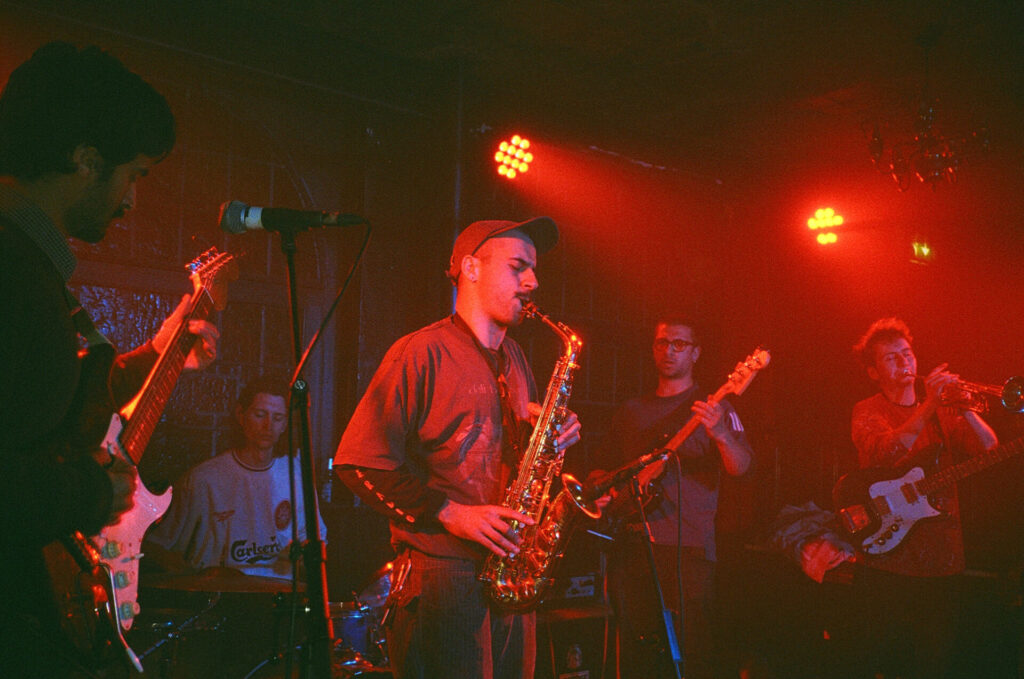
Leather.head’s Mud Again, their incendiary self-released debut, was one of the finest and most fully realised rock albums of 2025. The real deal.
Across its 37 minutes, the South London rascals’ fractured collage of blasted Slint guitars and explosive brass arrived perfectly formed. A cocktail of Midwest emo, jazzy post rock and hellfire punk rock, the album is made up of eight jagged sound-worlds that live and breathe and wheeze and writhe with the whims of the group creating them.
This chemistry, this natural intuitiveness, hasn’t arrived out of thin air. Formed in Brighton in 2016 by two brothers Toby and Josh Evans-Jesra, the group had been playing together for nine years by the time their debut album was released last November, and ideas and energies had doubtless been bouncing around for whole lifetimes before that. A move to London before the pandemic saw Toby and Josh joined by a third Evans-Jesra brother, Aidan, as well as drummer Cole O’Neill and guitarist Charlie Loane.
Sharing a telepathic understanding, Leather.head are a group of restless creatives with multiple projects on the go at once, often with each other. Loane makes DIY pop as Piglet, where the rest of the group back him. Toby, meanwhile, plays in a number of bands – slowcore duo Lobby (with Goat Girl’s Lottie Pendlebury) and the experimental, all-guitar Toby Evans-Jesra Quartet chief among them.
As well as a need to make music, there is also a second driving force for the individuals who make up the group – a desire to make the world a better place. All of them are activists, participating in various direct action and mutual aid projects across London. Perhaps most visibly this manifests itself in Solidarity Tapes, the not-for-profit label that the three brothers run together, which puts on fundraisers at Piehouse Co-Op in Deptford and beyond in aid of worthy causes – “Emos For Palestine” and a joint initiative with the Calais Food Collective being the two most recent.
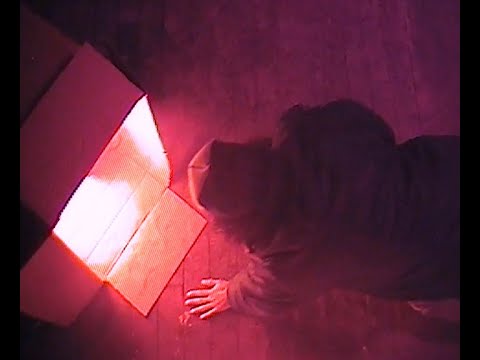
Solidarity Tapes “aim[s] to platform marginalised voices and strengthen the link between culture and activism,” as their online presence puts it. It is fair to say that Leather.head share the sentiment. Atop the noisenik skronk, lyrics are often overtly political and always deal with the rawest of human emotions.
“I don’t know if it’s an obligation,” lead singer and guitarist Toby tells me over Zoom when I ask him how necessary it feels to entwine music and activism. “It’s something we all do in our lives anyway, so there is no need to keep the two things separate. But it can be a powerful way of spreading a message or awareness.” Leather.head are all forthright in their belief that artists, nay, people, should all be doing what they can. “Me and Cole play in a Lord Of The Rings covers band called Mount Doom,” he continues. “If I can talk about it when I’m on stage dressed as the Witch-king of Angmar, other people can too.”
“Especially since the escalated genocide in Palestine,” adds his brother Josh. “It feels necessary to counter the bullshit in the media. You need to try and instill in yourself, and others, that you’re not powerless. There are things that people can do.”
“Certainly when I was younger, it could feel quite isolating caring about something,” he continues. “But being at a gig, and seeing people use their platform made me feel connected.”
“Even if you’re not able to write songs about these things,” says O’Neill, the band’s drummer. “You should still use your position to say, ‘we support this, and we think you should too’.”
The genocide in Palestine is something that has particularly inspired the band to kick back against the pricks. In a recent live session for State51, they performed with hand-sewn Palestinian flag patches stitched into their clothes, and make a point of mentioning it at every live performance.
In 2024, the group released From The River To The Sea. Their first collaboration with the North London poet Zia Ahmed, it set tender spoken word to scorched improvisation; mournful sax and guitars ringing out with real Branca clang. “Colonisers, fascists, terrorists,” go Ahmed’s words. “You’ve made your beds in homes of those you’ve dispossessed.”
“Zia’s a legend. We wanted to collaborate with Zia for a while,” Toby continues. “We loved what he did with the jazz drummer Sarathy Korwar. We’d see him at protests, and be too nervous to speak to him. But now, he comes on tour with us, and we spend Christmases together.”
Ahmed cements his status as a key collaborator by returning on ‘Death Healer II’, one of Mud Again’s most delicate moments. His poetry sits perfectly alongside Toby’s melancholy refrain of: “It will all be mud again.”
An opus of grief, outpour of rawest emotions, it is inspired by the loss of a parent – the Evans-Jesra brothers lost their father to cancer in 2016, and credit his love of music and values as an eternal inspiration. Ahmed’s spoken word is the emotional gutpunch: “I stand still and I miss the train,” the poet utters in deadpan. “I don’t know where summer went.”
Toby’s own lyrics are similarly fraught with angst and outrage, both political and personal. The most memorable refrain from ‘World.Building’ sees him softly creaking: “I’ve seen hell on my phone.” The protest song can be a dusty artefact, and it’s hard to recall much political music, or rock music on the whole, that so heavily references modern technology, but Leather.head do this a few times.
“Everyone’s watching the same thing,” Toby says. “It’s a head-fuck. You’re seeing the worst things imaginable. Wait, no, you’re seeing things so bad that you couldn’t have ever even imagined them. And then the next thing you’ll see is a dinner someone’s made.”
On a similar theme, ‘Train Tracks’, Mud Again’s emotional centrepiece (Toby quips: “one of our friends called it ‘slowcore ‘Bohemian Rhapsody’’’) is about “action and inaction” according to Toby. “It’s about how people can put their safety, liberty, and freedom on the line for people they haven’t even met.
“I always think people are going to ask, ‘what did you do while this was going on?’ I want to be on the right side of history.”
The spirit of community, a love of human connection fuels Leather.head, reflected in the fact that the band all get a turn singing on Mud Again. “Josh used to do joke screams,” Toby says. “And I’d think it sounded really, actually, good.”
“It was never a joke to me,” Josh laughs back. “I think my biggest contribution to the band is that I suggest scream parts for every song.”
Meanwhile, ‘Bastards’, the album’s most explicitly political song, sees guitarist Loane take the mic, a searing performance delivered in broad Northern Irish accent. “Behind the visor is a man with a family, but bad men have families too,” he rasps, on one of a handful of goosebump moments on the debut album. Loane previously fronted beloved DIY punk upstarts Great Dad in the late 2010s, and the brothers credit his appointment in 2018 as being transformative for the group. “That’s when it went from being loose to really cohesive,” says Josh. “Before he joined, we would only practice at live shows, but then we started to behave like a proper band.”
Throughout Mud Again, you can trace Leather.head’s influences pretty straightforwardly. O’Neill plays the drums with a math rock scuttle, and the spidery post rock of Slint and post-reunion Swans is all over the guitarwork. Perhaps the biggest shared influence, though, is a love of emo, primarily, but not exclusively, the Midwest emo practised by American Football and early Modest Mouse.
Emo, strangely, considering its cultural homogeneity for people growing up in a certain age, is still something of a dirty word in the UK’s indie, post punk and noise rock scenes. Everyone grew up around it, lots of those people loved it, but in spite of a recent Gen Z-inspired popularity spike, scarcely do millennial bands ever list it as an influence. A real elephant in the room.
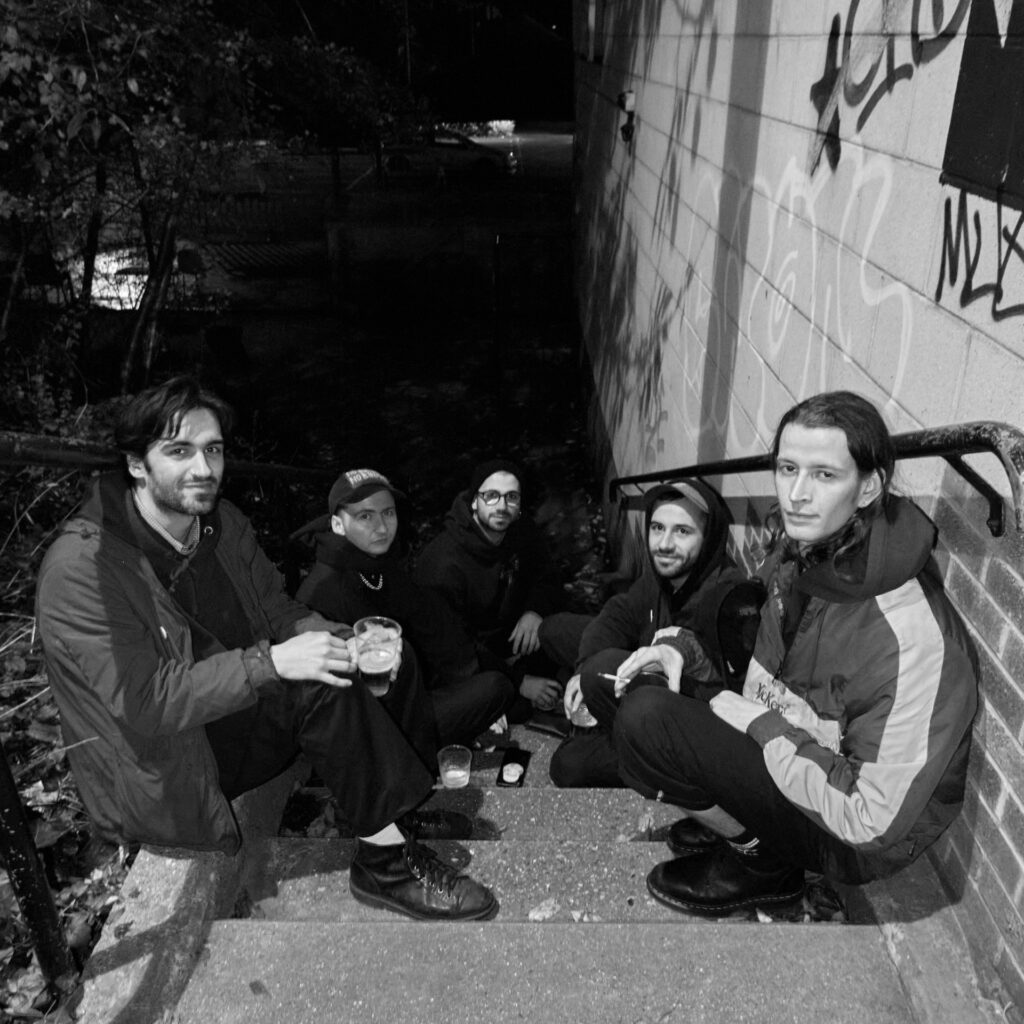
“Me and Josh were massive emos,” Toby explains. “Maybe Aidan was a bit too young. My hair is straight anyway, but I’d straighten it more, and listen to My Chemical Romance, and all of that stuff. And we got older, and discovered the older subgenres of it that maybe hold up slightly better.”
“I think when people think of emo, they think of ‘mall emo’, with the hairstyles and whiny vocals, some of which has a bad rep for a good reason,” Josh continues: “And I do have love for some of that still. But then you come across 80s post hardcore and 90s emo, Faraquet, Orchid, American Football, and it is more DIY, more underground, political. It might be a bit on the nose to say, but a lot of the mainstream stuff was very individualistic, and the 90s stuff was a lot broader, and that is what has connected with all of us.”
“I love that song by Cowboys Became Folk Heroes,” O’Neill chimes in. “‘Direct Action Gets the Goods.’ But My Chemical Romance and Los Campesinos! are bands that will never die in my heart.”
Ultimately, whether emo or beyond, Leather.head’s favourite music usually comes from DIY scenes, whose ethos and community is critical to the band. Their masterful debut would not exist without it, and the band would be unable to tour without a Pan-European network of like-minded comrades. They sit at the centre of a scene of eclectic DIY musicians in South London, and whilst they recognise that these are precarious times to work as artists in the UK’s capital, they are driven by the fact that there are always things they, and you, can do to make the world a better place.
Leather.head’s debut album Mud Again is out now. The band embark on a UK tour from 18 to 28 February. Full dates and tickets can be found here